How to create an online memory box for someone who has died
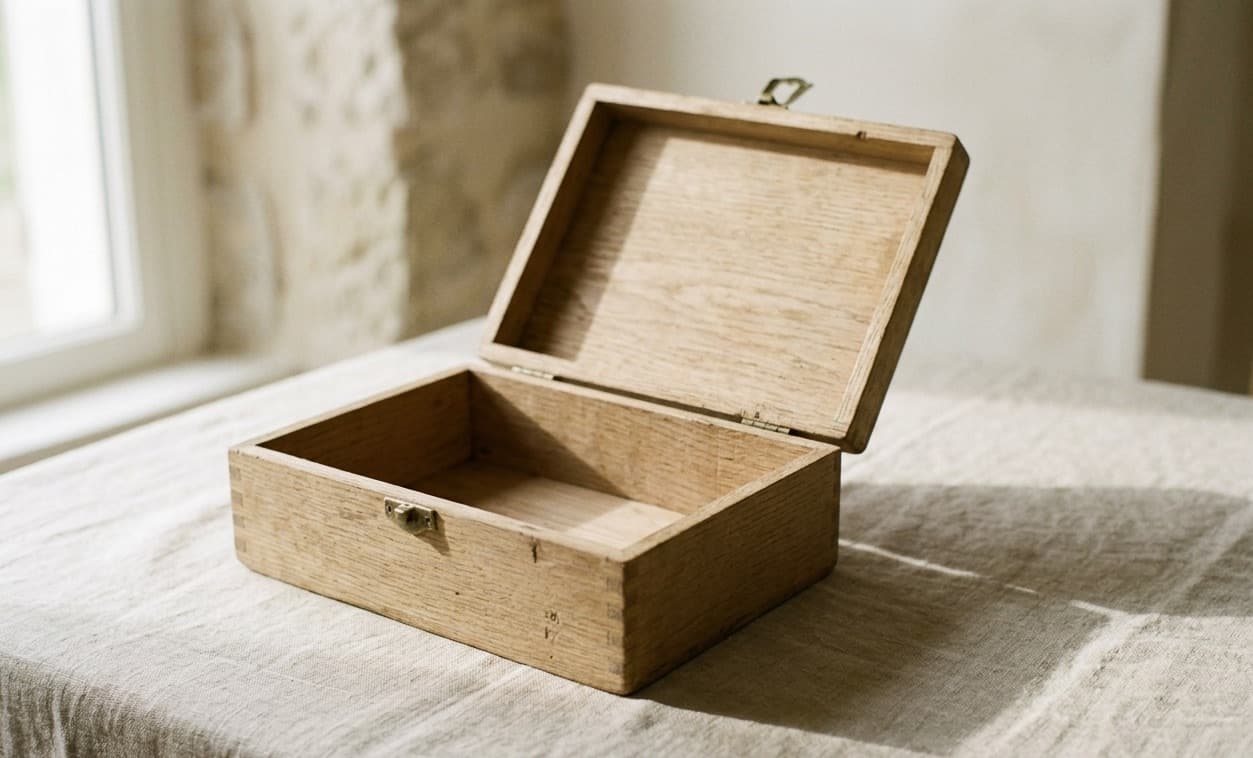
Most people know what a memory box is, even if they have never made one. It is the shoebox at the top of the wardrobe, or the drawer that does not quite close: a few photographs, a watch, a letter, a concert ticket nobody threw away. You put things in it that you cannot bear to file and cannot bring yourself to bin.
The trouble is that more and more of what you would want to put in that box no longer has a physical form. The voicemail where she is laughing too hard to finish the sentence. The last text he sent. The voice note about nothing. The four hundred photos on a phone that is now locked, because the only person who knew the passcode is the person who died.
A physical memory box cannot hold any of that. An online one can, and once you stop thinking of it as a shoebox it can be far more than the shoebox ever was.
What is an online memory box?
An online memory box is the same idea as the physical one, moved somewhere the digital things can live. A place that holds what brings a person back: their voice, their face, the way they wrote, the things they said. It is one practical, concrete way of keeping someone's memory alive after they die.
We have inherited the shoebox as if its smallness were the point of it. It was not. The box was small because it had to be. Photographs cost money to take and to print, so there were not many of them. A house had a finite number of shelves. The box was the bit you could keep to hand, not the whole of a person, and most of what someone was went unrecorded and was simply remembered, until it wasn't.
That world has gone. Almost everything now leaves a trace: photos by the thousand, voice notes, years of messages, video of an ordinary Tuesday. The limit that kept the shoebox small no longer applies, and that changes what a memory box can be. Not a relic or two on a shelf, but a place you can step into and be surrounded by someone.
What to put in an online memory box
There is no correct list, but some things earn their place more reliably than others. In the time I have spent watching families build these, the first thing added is almost never the good studio photograph. It is a voicemail, or a blurry picture taken on a phone.
Their voice, first. This is the one people forget they can lose and then cannot believe they nearly did. A voicemail. A voice note. A few seconds of video where they are talking, not posing. If you have a recording of them singing happy birthday badly, that is worth more than any portrait.
Then the writing that sounds like them. Not the birthday card with the printed verse, but the postcard with the three lines of nonsense, the text that still makes you laugh, the email signed off the way only they signed off. Screenshots count. A photo of a handwritten note counts.
Photographs, of course, and now you will have many. The ones that earn their place are rarely the posed studio shots. They are the candid ones: someone caught mid-laugh, the out-of-focus kitchen photo where everyone is talking over each other. They are closer to how the person actually was. Keep plenty, and lead with those.
And the small documentary things that fix them in a time and place: the recipe in their handwriting, the playlist they made, the daft running joke in a family group chat. These are the details that bring someone back more sharply than any summary of their life ever could.
Start with the things that are about to disappear
If you do nothing else, do this part early, because some of it is on a timer.
Voicemails are the most fragile. Most phone networks clear a voicemail box automatically after a set period, sometimes as little as a month, and they do not ask first. If there is a saved voicemail from them, get it off the network and into a file you control before anything else. On most phones you can save a voicemail as an audio file and email it to yourself; if you cannot work out how, a phone shop will usually do it in two minutes.
Phones themselves are the next problem. A locked phone with no known passcode is a vault, and the photos and messages inside it can be very hard to reach once the person is gone. If you can still get into their phone, do not wait: back up the photos and save the message threads that matter while you can.
Social media accounts are slower but not permanent. An account can be deleted by a relative who means well, memorialised, or simply lost when nobody renews the email it was tied to. Facebook in particular lets a chosen person download an export of the account, which is the honest, account-holder's way to get the photos and posts out rather than scraping them. What to do with someone's social media accounts after they die is a longer subject in its own right, and one worth reading separately before you start deleting anything.
The principle underneath all of this is simple: get the irreplaceable things off other people's systems and into something you hold, first. Sort them out later. You can always tidy. You cannot un-delete a voicemail.
How big should an online memory box be?
So how much should go in? More than the shoebox ever held, and that is the point, not a problem to manage.
The thing worth avoiding is not volume. It is deadness. A raw backup of an entire phone, dumped somewhere and never touched again, is not a memory box; it is a filing problem you have left for later, and later you will not do it. Nobody opens it because there is no way in. That is the failure to design against: not too much, but a pile so undifferentiated that it might as well be locked.
A good online memory box is the opposite of a backup. It is a place you go on purpose, and can wander. The volume is a feature, because being surrounded by years of someone is closer to having them back than any careful selection of three perfect things. The work is not cutting down to the bare minimum. It is making the abundance somewhere you would actually want to spend time: browsable, dated, with the good things easy to land on.
So do not be too precious about what earns a place. If it sounds like them, looks like them, or fixes them in a moment, it belongs. You are not building a tasteful exhibit. You are keeping somewhere you can be with them.
Where to keep it so it lasts
Wherever you keep it, the question to ask is: will this still open in ten years, and does it depend on me remembering it exists?
A folder on your own computer or phone is the easy default and the weakest answer. It depends on one device, one person, and one set of passwords. When that person forgets, upgrades the laptop, or dies in turn, the box goes with them. If you do keep it this way, at least keep a copy in two places.
A shared cloud folder is better, because more than one person can reach it. The risk is that it is tied to one account and one bill, and a memory box is not much use if it vanishes the month a card expires.
A dedicated place built for this is the sturdiest option, provided it is somewhere you trust to still be standing and to keep the contents private by default. The questions worth asking of any such place are plain ones. Who can see this. What happens to it if I stop paying or stop logging in. Can I get everything back out if I want to leave. If a service cannot answer those clearly, it is not somewhere to put the only copy of a voice you cannot replace.
Letting other people add to it
This is where an online memory box becomes something a shoebox never could: fuller than any one person could ever make it.
You only ever saw part of someone. You were not at the wedding before you met them, the work leaving do, the holiday with their old friends. Other people hold the rest, and now they hold it in enormous quantity: their own photos of your person, the voicemail still saved on someone else's phone, the thread in a group you were never in. Gathered together, all of that comes far closer to the whole of a life than anything you could assemble alone.
The usual way to collect it, a group chat asking everyone to send what they have, works for about a week and then stops. It asks people to dig through their own phones, find the thing, and send it on, and most of them mean to and never do. The good stuff stays stuck on other people's devices.
Gathering memories from family and friends well is most of what makes a memory box feel complete, and it is the one real reason to use something built for the job rather than a folder. The thing a folder cannot do is let your aunt, who is not technical and will not make an account for anything, add the photo she has been meaning to send straight into the box from her phone, in the time it takes to find it.
That is the part we built Northstar Keep around, and it is the only thing I will say about it here: an online memorial people can add to without making an account, so it fills up with what everyone else was holding instead of leaving it stuck on their phones. Use that, or a shared folder, or a literal shoebox if a shoebox is all it needs to be. The instinct is older than any of the tools.
And it does not get finished. That is the difference between a box and an archive: an archive is closed once it is full, but a memory box keeps being added to, on birthdays, on bad days, by people you have not heard from in years. Start with the one thing that is on a clock, the voicemail, before the network wipes it. Then let it grow. The aim was never to reduce a person to a few keepsakes. It was to keep enough of them, in one place, that you can go there and for a while be surrounded by them again.
Steve
Steve is the co-founder of Northstar Keep, where he spends his time thinking about how families hold on to the people they've lost.
Published